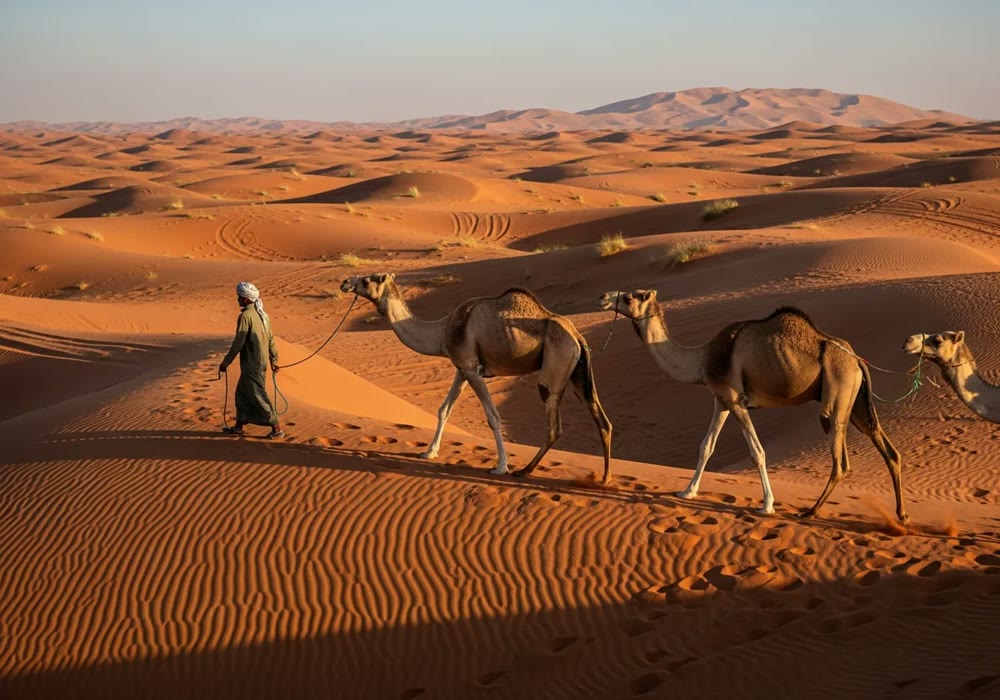
What camel ride options does Al Jazeera Tours offer?
Quick answer: Two bookable rides run on the Lahbab dunes — the 30-minute Desert Camel Ride from AED 150 per person, and the Sunset Camel Ride from AED 220 per person for the golden-hour dune-crest photo.
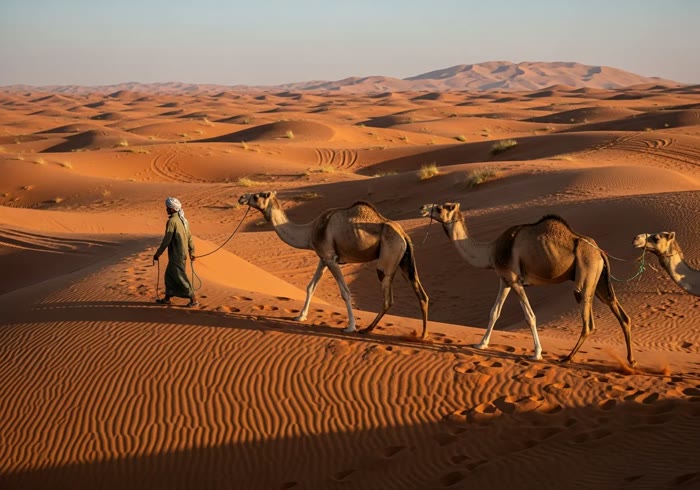
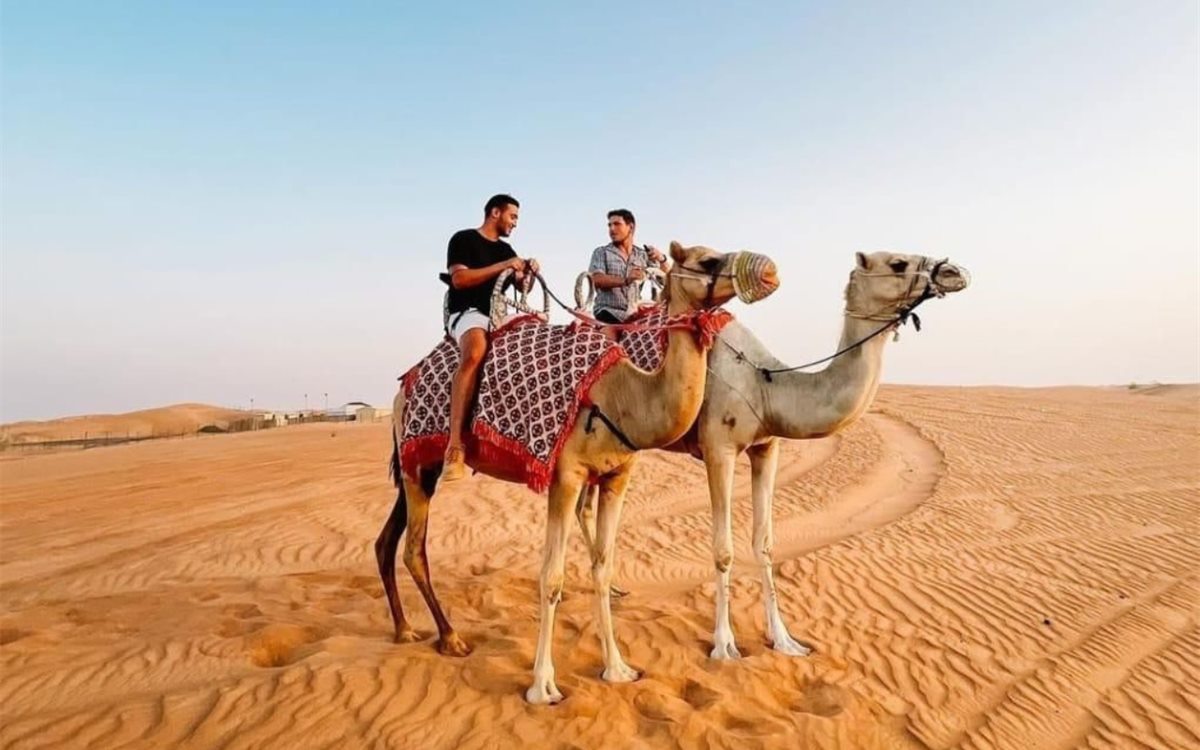
Both rides use the same format: a slow guided walk on a Bedouin-style camel, led by a handler on foot holding a lead rope, out on the sand east of Dubai. You don't steer, and the camel doesn't move faster than a walking pace at any point. The handler sets the route, stops at a dune crest partway through for photos, then brings you back to the staging area. Hotel pickup from most Dubai zones, the handler, and that photo stop are included on both rides — the difference between the two options is timing, not the experience itself.
The Desert Camel Ride is the standard 30-minute slot, usually run in the morning, and tends to suit families with young kids, first-time visitors, and anyone who wants the traditional camel photo without waiting for a specific time of day. The Sunset Camel Ride runs the same 30-minute format but timed so the dune-crest photo stop lands during golden hour, which is why couples and photographers tend to book it specifically for the light rather than the ride itself being any different.
Both prices are listed as 'from' figures because pickup zone and group size can move the final number slightly — the exact price gets confirmed on WhatsApp when you book, not locked in at checkout. Most bookings are pay-on-arrival with no deposit needed; the team will flag it upfront if your specific booking is one that asks for a small confirmation deposit instead.
A third option — a beach camel ride at JBR — comes up often in searches, but it isn't bookable through this page yet. It's held in draft while operating permission gets sorted out, so if that's specifically what you're after, message the team on WhatsApp for the current status rather than assuming it's available alongside the desert and sunset rides.
Neither ride requires previous riding experience, and there's no age cutoff on either end beyond what's covered in the safety section further down this guide. If you're booking for a mixed group — some riders wanting the classic desert setting, others wanting the sunset photo specifically — it's fine to split the group across the two different time slots rather than forcing everyone into the same booking; the team can coordinate pickups so the group still travels together even if they're riding at different times of day.
Desert vs sunset camel ride — what's the difference?
Quick answer: Same walk, same handler, same dunes — the real difference between the two rides is pickup time and photo light, not what happens once you're on the camel.
Pickup timing is the most practical difference. The desert ride usually picks up between 8:00 and 9:00 AM, while the sunset ride's pickup window shifts with the season — around 4:00 to 5:30 PM in winter, later at 5:30 to 6:30 PM in summer when the sun sets further into the evening. If your day is already packed with other plans, that timing difference is often what decides which slot actually fits your schedule.
The other difference is light, and by extension the photos you come home with. The morning ride gives you softer, cooler-toned photos against the dunes. The sunset ride times the dune-crest photo stop for golden hour, when the low sun throws long shadows and turns the sand a deeper red — it's the shot most people picture when they think 'camel silhouette on a dune'. That's the specific reason the sunset slot costs more: AED 220 per person against AED 150 for the standard ride. You're not paying for a longer or different ride, you're paying for the timing that gets you that particular photo.
Temperature plays a role too, though it cuts both ways depending on the season. In summer, the cooler morning slot is usually more comfortable for both you and the camel. In winter, either slot works fine, which is part of why sunset bookings pick up noticeably in the October-to-April months — the weather doesn't force a choice, so people default to the photo they want.
If you're not fussed about golden-hour light and want the lower price, book the standard desert ride. If the sunset photo is the actual reason you're booking a camel ride at all, pay the difference and book that slot specifically — arriving for a desert-ride time slot won't get you the same light.
The exact sunset window moves through the year because the sun itself doesn't set at the same time every month, which is the reason the pickup range spans a full ninety minutes rather than a fixed clock time. Booking closer to your travel date means the team can lock in the correct pickup slot for that specific week instead of an estimate — worth doing if the golden-hour photo is the whole reason you're booking the sunset ride in the first place.
Can I combine a camel ride with a desert safari?
Quick answer: Yes, but they're two separate bookings — the desert safari already includes a short 5-10 minute camel photo circuit at camp, not the full 30-minute ride.
This is the single most common mix-up guests run into. Book the evening desert safari (AED 375 per person) and you already get a camel moment built into the itinerary — a brief, guided photo circuit at the camp, usually 5 to 10 minutes, aimed at giving you the classic camel-and-camp photo before dinner and the shows start. It's a nice extra, but it's not the same thing as the dedicated camel ride, and if you show up expecting a real 30-minute walk out of that safari inclusion, you'll be disappointed.
If you want the actual ride — the full walk to a dune crest with its own photo stop — that has to be booked separately, either the desert or sunset camel ride. Nothing stops you from doing both in the same trip: some guests book a morning or midday camel ride, then head into the evening safari later the same day for the camp dinner and entertainment. The two bookings run independently, with separate pickups and separate confirmations, since they're not currently packaged as a single combo rate.
If the timing works for your itinerary, this pairing makes sense — you get the real camel-ride experience earlier in the day, then the fuller camp evening afterward without either activity feeling rushed. Just message the team on WhatsApp with both dates and times you have in mind so pickups don't overlap, and confirm both bookings separately rather than assuming one covers the other.
There's a practical reason the two aren't bundled into a single combo rate. The safari camp and the camel-ride staging area aren't the same location, group sizes on each booking can differ, and the safari's camel photo circuit runs on the camp's own schedule around the BBQ and shows rather than a fixed slot. Trying to force those into one price would mean either overcharging guests who only want one of the two, or underpricing the dedicated ride itself. Keeping them separate means you only pay for what you're actually booking, and either one stands fine on its own if you decide you only want one.
Is the camel ride safe for kids and older guests?
Quick answer: Yes for most kids and older guests — the walk itself is slow and controlled, and the two-stage kneel when mounting and dismounting is the one moment worth flagging ahead of time.
For children, a parent typically walks alongside or rides on the same camel with a young child seated in front of them, depending on the child's age and how confident they are with the motion. There's no fixed minimum age published, because what actually matters is how the child handles the camel's rise and sit — that gets confirmed with the handler at the staging area rather than off a form filled in beforehand. If you're booking for a young child, mention their age when you message on WhatsApp so the team can talk you through what to expect.
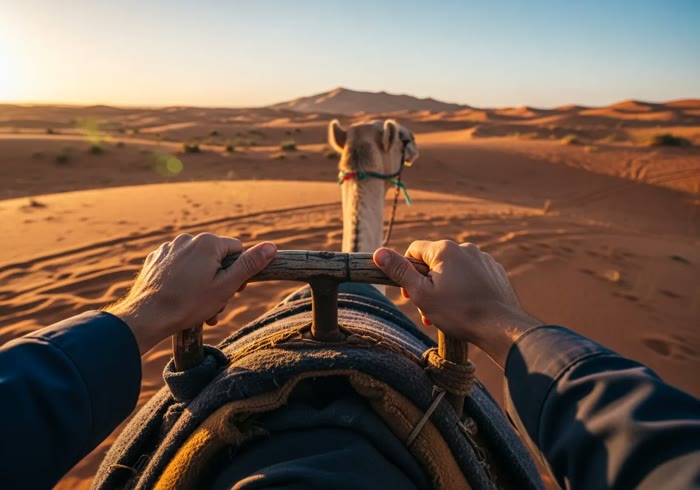
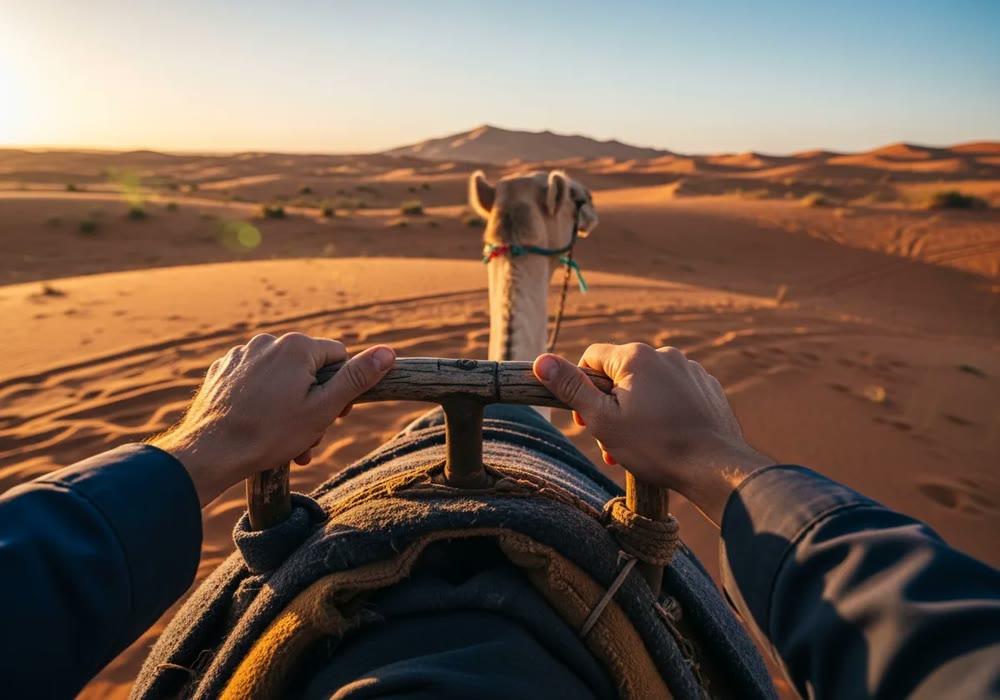
For older guests, the walk itself isn't physically demanding — you sit on the saddle and hold the horn while the handler leads at walking pace. The part that takes more consideration is the mount and dismount, when the camel rises and kneels in two stages, back legs first then front. That motion puts some stress through the lower back and can catch anyone off guard the first time. It's not dangerous, but if a guest has a back condition or limited mobility, it's worth knowing about before booking rather than discovering it at the staging area.
The practical approach either way is to say something upfront. Mention a child's age, a back injury, a fear of animals, or any mobility concern when you book, and the handler can adjust — a slower mount, extra support during the rise, or simply talking a nervous rider through the motion before it happens. Guests who flag concerns ahead of time tend to have a smoother experience than those who mention it for the first time standing next to the camel.
Multi-generational bookings — grandparents and grandkids on the same trip — are common enough that the handler is used to pacing a group with both ends of that range in it. In practice that means the handler checks in with the slower or more hesitant rider before moving the group along, rather than rushing anyone to keep to a fixed schedule. If your group has a wide age spread, it's worth saying so on WhatsApp when you book, since it can help the team plan which camels and which order riders mount in, especially if a grandparent needs a bit more time getting settled in the saddle before the walk starts.
What animal welfare standards does Al Jazeera Tours follow?
Quick answer: Camels in the riding fleet rotate to limit daily saddle time and rides pause during peak summer heat — we don't claim formal welfare certifications, just that handlers follow standard local practice.
The two concrete measures we can point to are rotation and heat management. Camels used for rides don't stay under saddle all day — they rotate through the fleet so no single animal is carrying riders continuously, which limits how much saddle time each camel logs in a day. On the heat side, rides typically pause during the hottest stretch of the day in summer, roughly 11:00 AM to 3:00 PM from May through September, when working the camels in that heat isn't something we're willing to do regardless of guest demand for a midday slot.
What we won't do is advertise specific welfare certifications, because we don't hold any — plenty of camel-ride operators in Dubai make broader claims than they can actually back up, and we'd rather be upfront that our practice is rotation and heat-pausing rather than a formal accreditation. If animal welfare is a specific priority for your booking, message the team on WhatsApp before you book and ask what you want to know directly; we'll tell you plainly what we can and can't confirm rather than giving you a reassuring answer that overstates it.
If you're comparing camel-ride operators for this reason, it's worth asking the same direct questions of anyone you're considering — how often the camels rotate, whether rides pause in extreme heat, and whether any certification claim is actually verifiable or just marketing language. We'd rather answer those questions honestly and under-claim than promise a standard we can't demonstrate.
This is partly why we don't chase a welfare certification badge just to put it on the page. A fair number of certification labels used in regional camel tourism aren't independently audited, and slapping one on a listing tells a guest less than actually describing what happens day to day — rotation, heat pausing, and a handler who's worked with the same animals long enough to know when one needs a break. If that changes and a credible, verifiable certification becomes available to us, we'd take it. Until then, we'd rather be specific about practice than vague about a label.
Can I do a beach camel ride at JBR?
Quick answer: Not yet — the JBR beach route is still in development pending operating permission, so it isn't bookable through this page. Ask on WhatsApp for the current status.
A beach camel ride at JBR, walking the shoreline with Dubai's skyline as the backdrop rather than open dunes, is a route we're actively working on rather than one we've decided against. Getting it to a bookable state means confirming operating permission and locking down exact meeting points along the beach, and until that's signed off, we're not going to list it as available and risk confirming a booking we can't actually deliver on the day.
In the meantime, the desert camel ride on the Lahbab dunes is the option that's actually running, and it gives you a different but comparable experience — soft red sand instead of a beach strip, dunes instead of a skyline, and a more traditional Bedouin atmosphere than a beachfront walk would have. If the specific appeal of JBR was the skyline-and-beach combination in your photos, the dune setting won't replicate that exact look, but it's the genuine, currently-operating alternative rather than a downgrade.
If JBR is specifically what you're after, the honest answer is to message the team on WhatsApp and ask directly where that route currently stands. We'd rather tell you it's still pending than quote a date we can't guarantee, so don't expect a firm launch timeline in that message — just an accurate read on where things are and whether it's worth waiting for versus booking the desert ride now.
If a striking photo backdrop is really what's driving the interest in a beach route, the sunset camel ride on the dunes is the closer substitute for now — same golden-hour timing, same dune-crest photo stop, just a red-sand backdrop instead of a beachfront skyline. It won't give you the exact JBR shot, but it's a real, currently-bookable ride rather than a wait with no fixed end date. We'd rather point you toward something we can actually deliver this week than have you hold off entirely for a route that's still working through permissions.
How do I book a camel ride, and what's the cancellation policy?
Quick answer: Message WhatsApp with your date, ride choice and group size; most bookings are pay-on-arrival with no deposit, and changes go through WhatsApp up to the day before.
Booking starts with a WhatsApp message to +971 52 440 9525 — send your preferred date, which ride you want (desert or sunset), your hotel name, and how many riders are coming. The team replies with the confirmed price for your group and pickup zone, along with the pickup time window for that slot. If you'd rather talk it through than type it out, the same team takes calls on +971 50 496 8087.
The faster your first message covers the basics, the faster you get a real answer back instead of a round of follow-up questions. Worth including upfront: the date, desert or sunset, how many riders (adults and kids separately if it matters for seating), your hotel or pickup area, and anything the handler should know in advance — a young child, a mobility concern, or a nervous first-timer. None of that changes whether you can book, it just means the confirmation you get back already accounts for it instead of getting sorted out at the staging area.
Most standard bookings are pay-on-arrival — cash, card or bank transfer, no upfront deposit. Premium and combo bookings may ask for a small confirmation deposit on WhatsApp. Changes and cancellations go through WhatsApp up to the day before your ride; the exact policy depends on how last-minute the change is, so message the team directly rather than expecting one fixed refund percentage for every case.
That last point is deliberate rather than vague. A change requested a few days out and a cancellation requested the morning of the ride aren't the same situation for the handler or the staging schedule, and quoting one flat percentage for both would either shortchange an early change or let a last-minute cancellation off too easily. Messaging the team directly gets you an answer that actually reflects your specific timing instead of a generic number stapled onto every booking regardless of notice.