What quad bikes can I ride in Dubai, and how much do they cost?
Quick answer. Three real tiers, priced per bike: COBRA Single Seater AED 200, standard Single Seater AED 250, Yamaha Grizzly AED 350 — all automatic ATVs on the Lahbab red dunes.
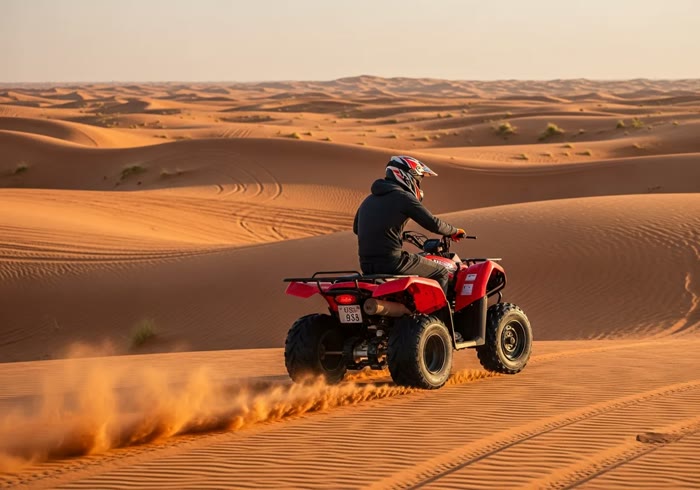
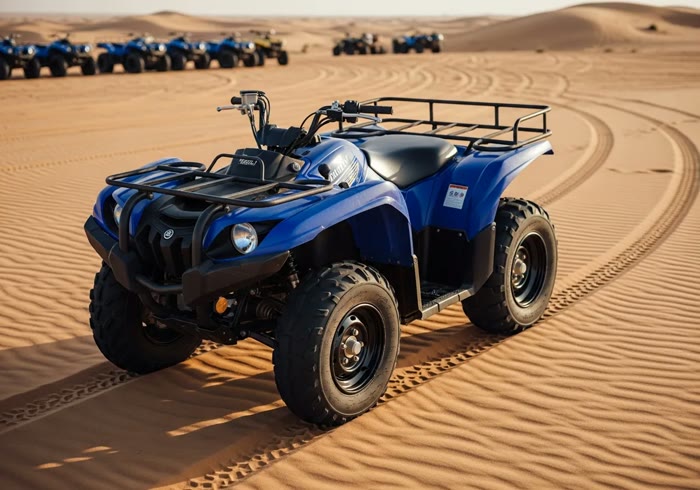
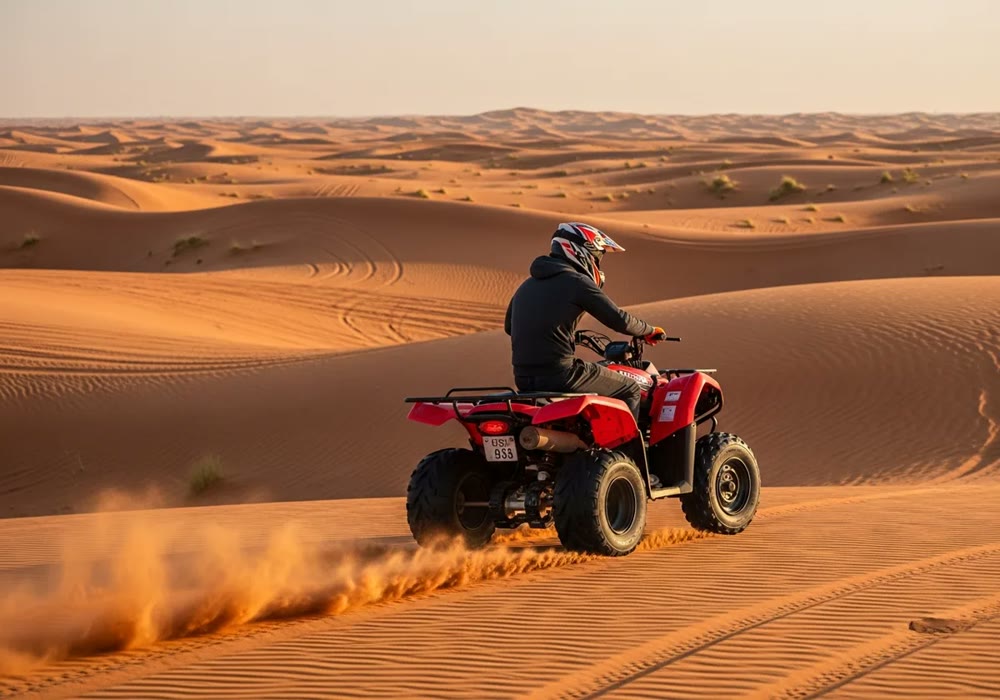
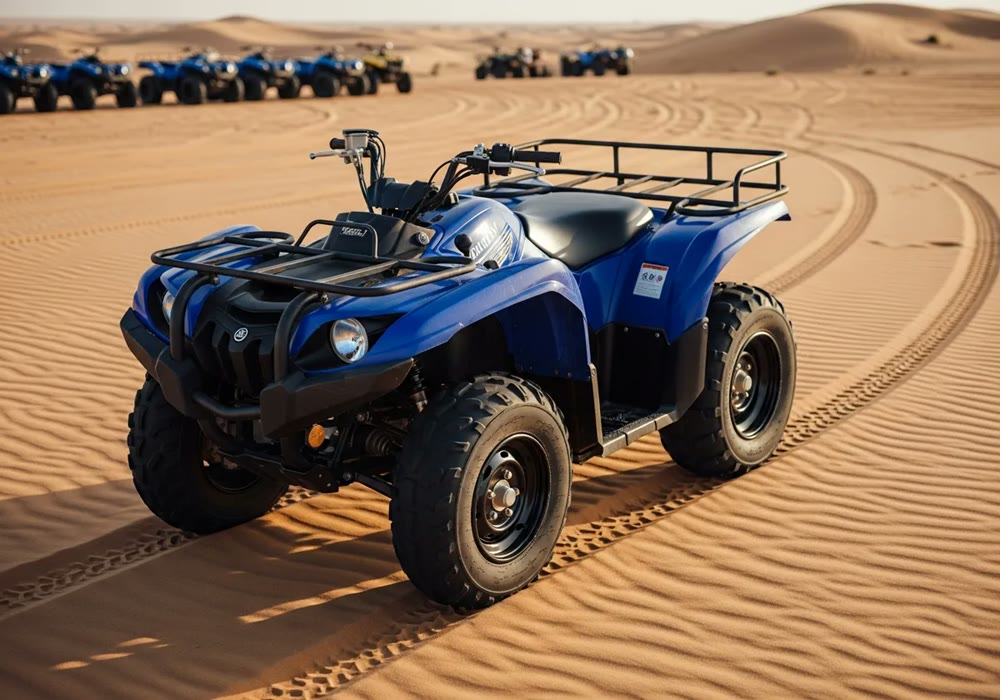
Three ATVs sit on the price list, and each one is priced per bike rather than per person, so a couple riding together books two quads, not one shared machine. The COBRA Single Seater is the entry model at AED 200 per bike for a 30-minute ride — light, easy to tip into a turn, and the bike handed to first-timers and anyone stepping up from the kids-zone practice track who wants a short taste of the open dunes. The standard Single Seater steps up to AED 250 per bike and stretches the ride window from 30 minutes to a full hour, with enough extra torque to hold a line on steeper dune faces without the throttle feeling maxed out. At the top, the Yamaha Grizzly runs AED 350 per bike for a full 1-hour ride. It's a heavier, 4x4-style machine with noticeably more low-end pull, built for riders who already know how to read a dune and want a bike that doesn't run out of push halfway up a climb.
None of the three need a UAE driving licence. They're automatic, twist-and-go machines, so the throttle does the work a clutch and gear lever would do on a manual quad. What changes between the tiers is weight, torque and how forgiving the bike is if you get the line wrong on a slope, not the licence requirement — that stays the same across all three.
Where you land within that AED 200 to AED 350 range usually comes down to riding time as much as bike choice. Book the COBRA if a half hour is genuinely the window you have — a lunch-break tour, or a first taste before an evening flight home. Book the standard Single Seater or the Grizzly if you've got a full hour to spare, because that longer slot lets the guide take the convoy past the flat warm-up stretch and into the terrain quads are actually built for. All three bikes ride the same route on the Lahbab red dunes, roughly 35 to 60 minutes east of the city depending on where your hotel sits, so the price difference isn't about the terrain — it's about how much bike sits under you.
Do I need a licence or experience to ride a quad bike?
Quick answer. No UAE driving licence is needed on any of the three tiers — all are automatic, twist-and-go ATVs, and a safety briefing plus guide support cover you from the first minute.
None of the three quads on this page need a driving licence of any kind, UAE-issued or otherwise. All three are automatic ATVs — you twist the throttle to go, let off to slow, and squeeze the brake lever the same way you would on a bicycle. There's no clutch, no gear lever and no manual shifting to learn on top of steering a dune line, which is exactly why the automatic format is the one nearly every operator in Dubai runs for first-time riders.
Experience isn't a requirement either, but it does change what your first fifteen minutes feel like. Every booking opens with a safety briefing and guide support before anyone rolls onto open sand — you're shown throttle control, how to shift your weight on a climb versus a descent, and how convoy spacing works so you're never riding blind into the rider ahead. Guests who've never touched a quad, a dirt bike, or even a bicycle with hand brakes usually settle in within the first few minutes of the briefing before the guide waves the convoy forward.
Where prior experience actually matters is bike choice, not eligibility. A rider who has handled a motorbike, ATV or off-road bike before will feel at home on the Yamaha Grizzly's extra torque straight away. A rider who has never controlled a throttle vehicle should start on the COBRA or the standard Single Seater, where the power delivery is gentler and mistakes are easier to correct mid-turn. Nobody is turned away for lack of experience — the briefing and guide support exist precisely to get a first-timer to a safe, confident lap — but the tier you pick should still match how comfortable you already are on two wheels or four.
Riders who've only driven a dune buggy before shouldn't assume the skills transfer directly. A buggy is a seated, wheel-steered vehicle with a roll cage and harness — a quad asks you to balance your own body weight, lean into turns, and manage a throttle with your thumb rather than a foot pedal. The two aren't difficult in the same way, they're just different, so treat a first quad ride as a genuine first time even if you've bashed dunes in a buggy before.
Can kids ride quad bikes in Dubai?
Quick answer. Yes, in a supervised, closed kids practice track — not on the open dune convoy, which stays an adult-tier ride across all three bikes.
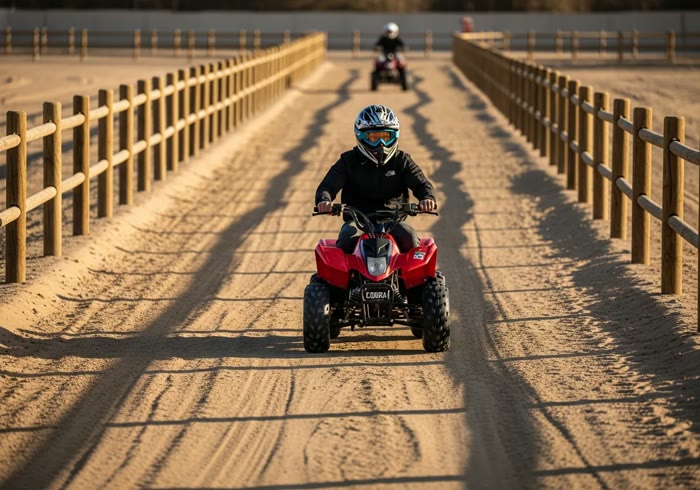
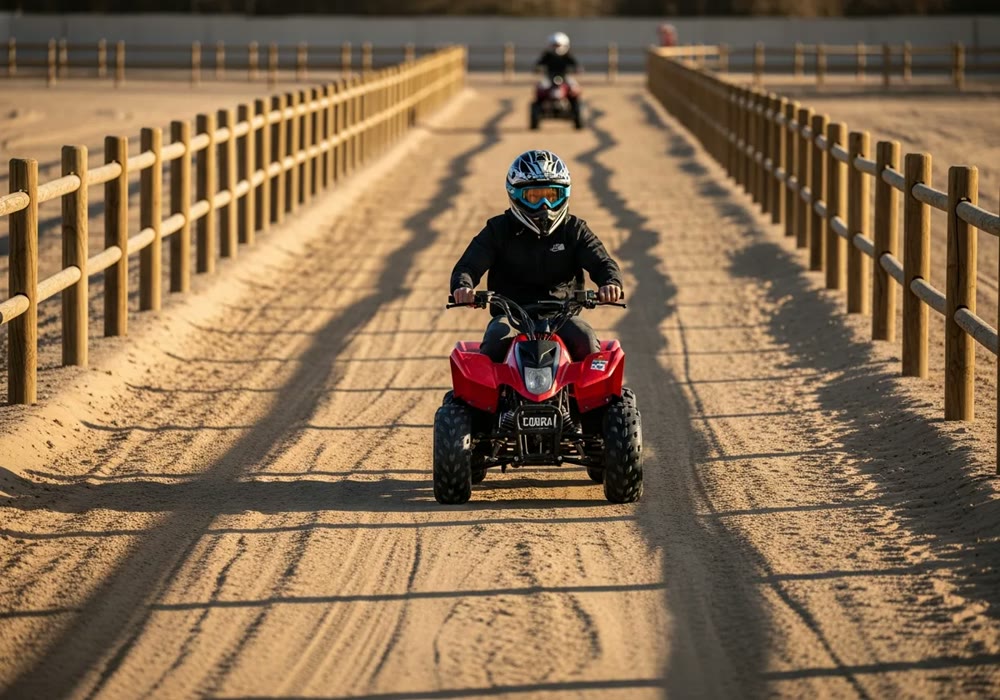
Kids don't ride the open desert convoy on any of the three quad tiers, and that's a deliberate line rather than a gap in what's on offer. What is available is a kids zone: a closed, supervised practice track set apart from the main dune route, where a child can sit on a quad, learn the throttle and brake, and ride laps under direct staff supervision without ever leaving a controlled, flat area.
The kids zone exists because the open convoy genuinely isn't the right environment for a young rider — dune faces, convoy spacing and sand-recovery situations ask for judgment a child hasn't built yet, even riding alongside a guide. The practice track sidesteps that. It's flat, fenced off from the dune field, and a staff member stays within arm's reach the whole time, which means parents can watch from right beside the track rather than trusting a child to a convoy they can't see into.
For families, the usual pattern is that the adults book one of the three priced tiers — COBRA, Single Seater or Grizzly — for the open convoy, while the kids' session on the practice track gets arranged and quoted separately when you message the team. That way everyone in the group gets a turn on a quad without putting a child on terrain built for adult riders. If your child is confident on a bicycle with hand brakes, the kids-zone bike usually feels familiar within a couple of laps; if this is their first time on anything motorised, the supervising staff member adjusts the pace to match rather than pushing a fixed lesson plan. Ages and sizing for the kids zone are confirmed on WhatsApp before you book, since it comes down to the child's size relative to the bike rather than a single birthday cutoff.
COBRA vs Single Seater vs Yamaha Grizzly — which should I book?
Quick answer. Book the COBRA for a first ride or a 30-minute window, the standard Single Seater for a full hour with more push, and the Yamaha Grizzly if you've ridden a quad or motorbike before.
Picking between the three usually comes down to two questions: how much riding time do you actually have, and how much throttle do you want under your thumb. The COBRA is built around the gentler end of that scale — 30 minutes, light steering, and a throttle that ramps up slowly enough that a nervous first-timer doesn't feel like they're fighting the bike. It's also the bike used for older kids stepping up from practice-track supervision to a full guided lap, since it forgives a heavy hand on the throttle better than the other two.
The standard Single Seater sits in the middle on purpose. The ride window stretches to a full hour, and the extra torque over the COBRA means dune climbs that felt like work on the entry bike feel more like momentum on this one. Most solo riders who've done any two-wheeled riding before — a bicycle on hills, a scooter, confident go-karting — land here rather than on the COBRA, because the hour-long slot lets the guide push further into the dune field once everyone's settled.
The Yamaha Grizzly is the bike to book if you already know you like ATVs, motorbikes or off-road riding and want the strongest machine on the price list. It's heavier, holds a line on steep faces with less rider correction needed, and the extra weight cuts down on the sand-kickback jitter you'd feel on a lighter bike at the same speed. It's not the bike to start on if you've never ridden anything with a throttle — save it for the second visit, or book it straight away if you already ride at home.
- Choose the COBRA if you have 30 minutes, this is your first quad ride, or you're riding right after the kids-zone practice track.
- Choose the standard Single Seater if you want the full hour and you've ridden anything with two wheels before.
- Choose the Yamaha Grizzly if you've ridden a quad, ATV or motorbike and want the strongest bike in the convoy.
Mixed groups don't need to agree on one bike. It's common for a group of six to split three ways — a couple of COBRAs for anyone riding for the first time, a Single Seater or two for the confident-but-casual riders, and a Grizzly for whoever already rides at home. The guide keeps the whole convoy together regardless of which bike each rider is on, so nobody gets left behind waiting on a slower machine.
What's included in a Dubai quad biking tour?
Quick answer. Helmet, goggles, a safety briefing and guide support come standard on all three tiers — the price difference between bikes is about the machine, not the safety kit.
Every one of the three quad tiers comes with the same baseline: a helmet, goggles, a safety briefing before you roll out, and guide support for the entire convoy. None of that changes whether you're on the AED 200 COBRA or the AED 350 Grizzly — the safety layer is identical across the fleet.
The helmet and goggles are fitted at the staging area rather than handed over for you to sort out yourself, with the strap and seal checked before anyone starts the engine — loose goggles on a windy dune day are the single most common complaint riders mention afterward. The briefing that follows covers throttle control, body position on climbs and descents, and how convoy spacing works, so by the time you're rolling you've already had a hands-on walkthrough rather than a rushed verbal warning.
Guide support runs the whole way through, not just at the start. A lead guide sets the pace and picks the route through the dune field, and stays close enough to step in if a bike stalls on a slope or gets bogged in soft sand — which happens occasionally and is treated as routine rather than an emergency. The kids zone carries its own layer of supervision on top of this, since a staff member stays within arm's reach of the practice track for the full session rather than circulating around a convoy.
Drinking water is handed out before the convoy rolls, and the guide schedules at least one photo stop on the dune crest partway through the ride, so you're not gripping the throttle non-stop for the full 30 minutes or hour. None of this changes by tier — a Grizzly booking gets the same water and the same photo stop as a COBRA booking, just from a bigger bike. The briefing itself is conducted in English, with the guide checking understanding before anyone is cleared onto the sand — if you're travelling with a non-English speaker, mention it on WhatsApp when you book so the team can plan accordingly.
What sits outside that baseline — hotel pickup zone, add-ons, ride durations beyond the standard slot — gets confirmed on WhatsApp at the time you book, since it depends on where you're staying and which tier you've picked. The core four — helmet, goggles, briefing, guide — stay the same regardless.
Best time of day and season to book a quad bike tour?
Quick answer. October to April, any slot works. May to September, book dawn or sunset — midday sun on an open quad gets genuinely uncomfortable.
Time of day matters more on a quad than it does in a caged buggy, because you're sitting in open air with a metal fuel tank between your knees and bare handlebars in front of you. From October through April, any slot works — mornings run coolest, and a late-afternoon or sunset booking usually lines up with the best light for photos on the dune crest.
May through September is where timing stops being a preference and becomes a comfort issue. Midday sun on an open quad in peak summer means handlebar and tank surfaces that get genuinely hot to the touch, on top of ambient heat that's already working against you. Dawn and sunset slots sidestep that almost entirely — the sand hasn't heated up yet in the morning, and it's cooling back down by early evening, so both ends of the day stay rideable even in August.
Sunset bookings tend to fill first regardless of season, partly because the light on the dune crest is the most photogenic part of the day and partly because the temperature drop makes the ride more comfortable after a full day of sightseeing elsewhere. Dawn slots are quieter — fewer convoys booked that early — and the sand is still settled from overnight, which some first-time riders find gives a smoother, more predictable surface than the softer, wind-shifted sand later in the day.
If you're choosing purely on comfort and you're visiting between May and September, treat dawn or sunset as the default rather than the exception, and save a midday slot for the cooler months only.
Daylight hours shift enough across the year that a "sunset slot" isn't a fixed clock time — it moves by more than two hours between December and June. When you book on WhatsApp, the team confirms the actual pickup time for your date rather than a generic evening slot, since a sunset ride in January starts noticeably earlier than one in July. Public holiday weekends and school holiday periods also get busier than a normal weekday, so if you want a specific slot — sunset especially — booking a few days ahead rather than the same morning gives you a better shot at the time you actually want.
How do I book, and what if I need to cancel or reschedule?
Quick answer. Message WhatsApp or call to confirm your tier and date. Most bookings are pay-on-arrival with no upfront deposit, and changes go through WhatsApp up to the day before your ride.
Booking is a WhatsApp conversation, not a form to fill in. Message +971 52 440 9525 with the tier you want — COBRA, standard Single Seater or Yamaha Grizzly — your preferred date, roughly how many riders, and your hotel name if you need pickup arranged. If you'd rather talk it through, call +971 50 496 8087 and the team will confirm the same details over the phone. Either way you get a straight confirmation back with the price, the pickup window and what to bring, rather than an automated booking page guessing at availability.
On payment: most standard bookings are pay-on-arrival — cash, card or bank transfer, no upfront deposit. Premium and combo bookings may ask for a small confirmation deposit on WhatsApp.
Changes and cancellations go through WhatsApp up to the day before your ride; the exact policy depends on how last-minute the change is, so message the team directly rather than expecting one fixed refund percentage for every case. A same-day illness gets handled differently from a change requested a week out, and the team would rather talk through your specific situation than apply a blanket rule that doesn't fit it.
If you're still deciding between tiers, or you want a group quote across COBRA, Single Seater and Grizzly bikes for a mixed party, that's also a WhatsApp message away — send the group size and the team will work out which combination of bikes suits everyone riding.
Response on WhatsApp is usually within minutes during the day, faster than working through a call centre or waiting on a contact-form reply. Having your date, preferred tier and hotel name ready when you message means the team can send back a real confirmation — price, pickup window, driver name and vehicle plate — in one exchange rather than several back-and-forth messages. If your plans are still loose and you know you want to ride but haven't picked a date, that's a fine way to open the conversation too — the team would rather help you land on the right tier and slot than have you guess and book the wrong one.